I invite you to discover the Rosary as more than an artifact or piece of jewelry. This simple chain of beads guides you through Scripture-based meditations while you pray familiar prayers like the Our Father and Hail Mary. Many hold a Rosary without knowing its power to deepen faith in Mary and draw closer to Jesus. I share this guide from my heart as a business owner passionate about helping others embrace this devotion.
Praying the Rosary follows a clear rhythm. You begin with the Sign of the Cross, Apostles' Creed on the crucifix, Our Father on the first bead, three Hail Marys for faith, hope, and love, then a Glory Be. Announce each mystery, pray an Our Father, ten Hail Marys while meditating, a Glory Be, and the Fatima Prayer. Repeat for five decades, then close with Hail Holy Queen and the Sign of the Cross. Find all prayers detailed on our site to start today.
The Joyful Mysteries suit Mondays and Saturdays. They center on Jesus' early life, starting with Mary's yes to God. Joy, trust, and discovery fill these reflections. God works through humility, service, and obedience in them. Embrace these to live a faithful, joyful life.
The angel Gabriel visits Mary and announces she will bear the Christ child. Mary responds with deep humility, saying yes as the Lord's servant. This moment invites us to surrender our plans to God's will. Shortly after, Mary hurries to aid her cousin Elizabeth, pregnant with John the Baptist. Mary's actions show selfless love in service.
I pray this mystery often because it reminds me to listen for God's call in daily life. Humility opens our hearts to divine purpose. We serve others just as Mary served Elizabeth without hesitation. Love of neighbor flows naturally from such trust. These fruits strengthen our walk with Christ.
Many misunderstand the Rosary, but these beads lead you straight to these truths. Picture Mary's fiat transforming ordinary moments into holy ones. Embrace humility by saying yes to small acts of service today. Love grows when we visit those in need, mirroring Mary's journey. Faith in Mary deepens through this prayer.
Jesus enters the world in a stable, born in humble conditions without comfort or acclaim. Shepherds and animals witness the Savior's arrival amid simplicity. This scene teaches us to cherish God's presence over worldly status. Gratitude fills our hearts when we trust Him in imperfection. Poverty of spirit frees us from chasing material wealth.
I reflect on the Nativity during busy seasons to recenter on true joy. Simplicity strips away distractions and reveals God's gifts. We practice gratitude by appreciating what we have right now. Trust in God sustains us through any circumstance. This mystery calls us to live lightly and faithfully.
Bethlehem's manger shows divine love chooses the lowly. Contemplate the Holy Family's peace in scarcity. Let go of excess to welcome Christ fully. Gratitude transforms ordinary days into celebrations. Poverty of spirit leads to profound spiritual richness.
Mary and Joseph present Jesus in the temple as required by law. Simeon and Anna recognize Him as the promised Messiah. Their faithful obedience fulfills ancient prophecies. Ordinary rituals become sacred through trust in God's word. This mystery bears the fruit of obedience in everyday faithfulness.
Obedience guides my business decisions, echoing Mary and Joseph's example. We follow God's guidance even when paths seem routine. Trust honors His promises spoken long ago. Small acts of devotion build lasting faith. Simeon and Anna teach patient waiting rewards obedience.
The temple scene unites generations in prophecy's fulfillment. Mary trusts amid wonder at her child's identity. Joseph upholds the law with quiet strength. Obedience aligns our lives with divine plans. Practice it daily to experience God's faithfulness.
Mary and Joseph lose Jesus during Passover and search anxiously for three days. They find Him in the temple, teaching among the elders. Jesus explains He must be about His Father's business. This event urges us to seek God persistently. Piety places Him at our life's center.
Piety shapes my prayer routine, drawing me back to Jesus amid distractions. The three-day search mirrors our own quests for deeper connection. Mary and Joseph's relief inspires continual seeking. We prioritize God above all activities. This fruit fosters a vibrant spiritual life.
The temple reunion highlights Jesus' mission from youth. Mary ponders these events in her heart. Joseph supports the family through trial. Piety ensures God remains our focus always. Let this mystery motivate your daily pursuit of Him.
These Joyful Mysteries invite you into moments of profound grace through the Rosary. Mary leads us gently, her faith illuminating Jesus' beginnings. Pick up your beads, follow the steps, and meditate on these truths. I offer prayer cards and booklets branded for your devotion, plus a variety of rosaries to enhance your practice. Contact me today to start this transformative path with the right tools in hand.
I remember first holding a rosary for a baptism, warm beads sliding through my fingers as family gathered and prayers rose. Yet I found many around me unsure how the rosary connects to the Church or why it matters for such moments. The rosary ties prayer, scripture, and the witness of saints into a single, meditative practice that centers our hearts on Christ through Mary and the Gospel mysteries. Over centuries this devotion evolved from early Christian prayer-keeping methods into the familiar decades we use today, and it remains a meaningful sacramental companion for baptisms, family prayer, and personal contemplation. I invite you to consider a rosary that will become part of your family’s spiritual life and to reach out if you want a custom rosary that truly speaks to your heart.
The Catholic Church regards the rosary as a meditative, Christ-centered prayer that leads the faithful to reflect on the life, death, and resurrection of Jesus through the lens of Mary’s faithful participation. The rosary combines vocal prayers—Our Father, Hail Mary, Glory Be, and the Fatima Prayer, with deliberate meditation on Gospel events called the Mysteries, directing attention to key moments of salvation history. This structure breaks the week into focused reflections so the faithful can ponder the Gospel’s highest points across daily life. The rosary has been taught and recommended by Church leaders as a powerful spiritual practice that fosters deeper union with Christ.
Because the rosary is Marian in form, some mistakenly think it centers on Mary instead of Christ, yet every decade calls the mind back to Jesus through Mary’s example and participation in salvation. Praying the mysteries trains the imagination and heart to enter scriptural scenes, from pilgrimage to Bethlehem, Nazareth, Calvary, and the Resurrection. The rosary becomes an accessible way to live the Gospel daily. The Church also recognizes the rosary as a source of consolation and spiritual protection, often recommended in times of trial, family need, or communal prayer intentions. Used regularly, it cultivates a rhythm of prayer that steadies the soul amid life’s distractions.
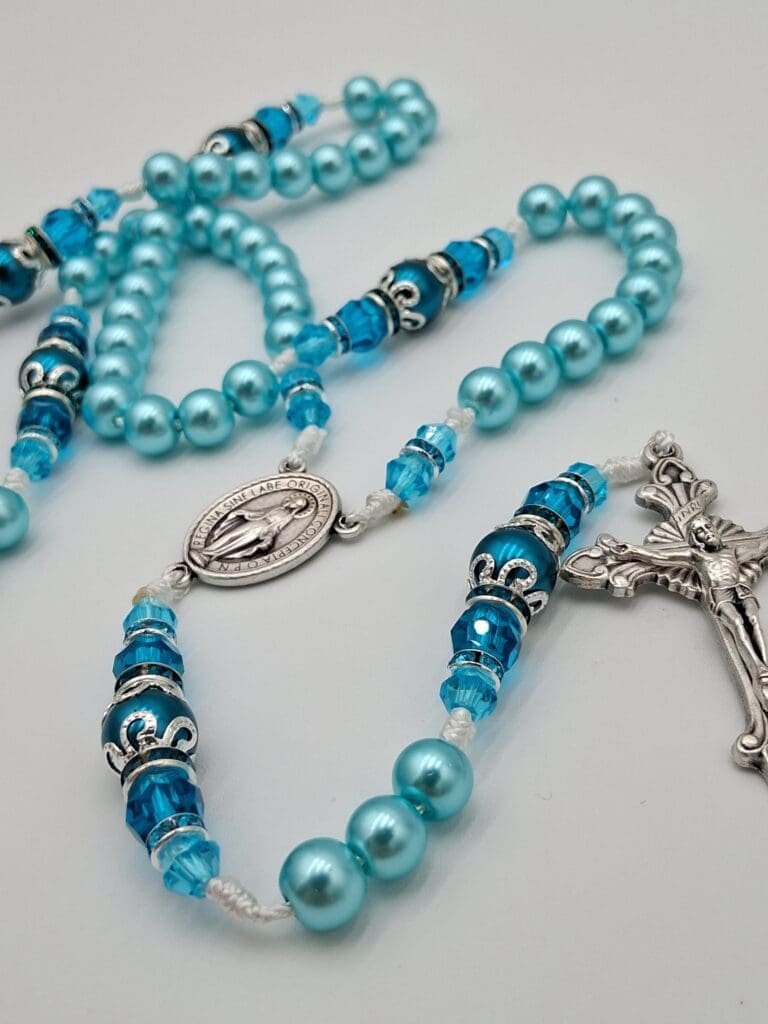
Practically, the rosary’s prayers and beads serve both body and spirit: the tactile repetition anchors attention while the meditative content forms devotion. Materials, weight, and design of a rosary can influence how easily someone enters into prayer. Crystal catches light in a morning window, heavy hematite can ground a sorrowful reflection, and a delicate pearl set may accompany a baptismal blessing. For families preparing for baptism, choosing a rosary that resonates can make the prayer tangible and memorable, connecting the baptized person and their loved ones to centuries of Church tradition.
Many saints throughout Church history embraced the rosary and helped spread its use, showing how this prayer deepened personal holiness and evangelized countless souls. Saints such as Dominic and Louis de Montfort promoted the rosary as a tool for conversion and consecration, presenting Mary’s maternal care as a pathway to closer union with Christ. Other saints taught the rosary as a daily discipline that steadied their hearts in ministry and suffering, testifying that contemplative repetition can fuel missionary zeal and interior peace.
Some saints’ stories demonstrate dramatic conversions tied to Marian prayer: a former ordained Satanist priest’s conversion and eventual sanctity illustrates the rosary’s power to restore and reconcile lives to God. Saints like Catherine of Siena praised Mary’s role in drawing souls to Christ, encouraging the faithful to let Mary’s maternal example guide their prayer. Contemporary and modern holy men and women, including those known for simple, committed service, frequently recommended the rosary for personal reliance on God’s mercy and for protection against spiritual trouble.
The rosary’s reputation as a “spiritual weapon” appears in the witness of saints and in popular devotion, taught as both a peaceful meditation and a means of spiritual resistance. Mother Teresa’s own counsel encouraging a clinging devotion to the rosary, which captures how saints saw it as a steadying habit in the midst of spiritual warfare and daily pastoral toil. For those preparing a baptismal celebration, entrusting prayers for the newly baptized to the rosary aligns the family with a broad cloud of witnesses who have prayed similarly for generations.
The practical roots of the rosary trace back to early Christian prayer practices and developed over centuries into the form most Catholics use today, which matters when you choose a rosary for a baptism. Early Christian hermits and monks in Egypt used stones and prayer ropes to count psalms, creating a tactile rhythm for prayer that foreshadowed later beads. Over time, around the medieval period, devotional patterns evolved into grouped prayers that reflected the Psalter and the life of Christ, eventually producing the decades and mysteries we now meditate upon.
Saint Dominic is traditionally associated with popularizing the rosary in the 13th century and encouraging communal recitation, while later figures refined the structure and emphasis of the mysteries for devotional use. The rosary’s development included practical adaptations—such as dividing the 150 Hail Marys into decades so busy people could still pray meaningfully. These skills make the prayer accessible for lay faithful across occupations and seasons of life. For a baptism, choosing a rosary that reflects this long, lived tradition can help families feel tied into nearly two thousand years of Christian prayer life.
Modern additions and confirmations, like the Fatima prayer and the Luminous Mysteries introduced by a recent pope, show the rosary’s living tradition and adaptability to new devotional needs. Knowing that the rosary has been used, refined, and cherished by saints and popes through centuries reassures families that their choice of a baptismal rosary is not merely symbolic but part of a historic practice meant to form faith. When you select or commission a rosary for baptism, you’re choosing an object that acts as a bridge from Scripture and the saints to future generations.
Modern life fragments attention with constant notifications, making it harder to carve out time for meditative prayer like the rosary. Social media, messages, and screens train us to skim rather than to dwell, and intentional prayer requires structured time and a gentle aid to hold our place in reflection. The rosary can act as that aid, a spiritual tool that channels distracted hands and minds toward a sustained encounter with Gospel mysteries.
I find that the choice of rosary influences how easily I enter into prayer: sunlight sparkling through Austrian crystals draws me into joyful reflection, while a heavier hematite set helps me settle into sorrowful meditations. You do not have to hold a rosary to pray the rosary, but the physical object often gives your hands something to hold and your attention something to follow. Treat the rosary like a spiritual fidget tool: it occupies restlessness and anchors your focus to prayerful remembrance.
Some people cherish a single rosary given by a loved one and never change it, and that steadfastness itself becomes a living sacramental. Others prefer a small collection, a lightweight rosary for travel, a beautiful keepsake for family prayer, and a durable bedside rosary for late-night consolation. Choosing a rosary for a baptism means picking an instrument that will both accompany immediate celebration and accompany ongoing prayer across a lifetime.
Finding Your Perfect Keepsake Rosary with Us
I want to help you find a rosary that will become a lasting keepsake for your family or a treasured gift for a newly baptized child. We offer a curated selection that considers material, weight, and style so each piece supports different kinds of prayer: joyful, sorrowful, luminous, or contemplative. If nothing in our gallery feels quite right, please email us with your special request and we will design a custom rosary using your preferred metals, colors, and materials so it truly reflects the soul it will accompany.
Custom rosaries make meaningful baptismal gifts because they carry thoughtful choices, stones that catch morning light, a cross that matches family heritage, or a bead material that recalls a loved one’s memory. The rosary becomes both prayer tool and family heirloom. We work closely with customers to ensure each custom piece balances beauty, durability, and prayerfulness so it endures daily use and sentimental worth. Let us help you create a rosary that will join your family’s prayers to the long history of saints and believers who have used this devotion to draw closer to Christ through Mary.
If the history and witness of the rosary move you, consider choosing a rosary for baptism that will serve as a lifelong companion in prayer; browse our collection to find one that resonates, or email us with your custom request so we can make the rosary that will hold your family’s prayers for generations. I love helping people find the rosary that fits their life and intentions, and I would be honored to help you select or design the rosary that will bless your baptism and deepen your family’s prayer life.
Understanding the rosary can, at first feel overwhelming, but we’re going to break this down and make it more inviting to try. First off, the rosary is about meditation. Okay, we hear this word all the time, but what is meditation anyway? It’s a practice that incorporates a mind-body experience to train for awareness and clarity. While the word “meditation” does not exist in the Bible, Jesus was known for regular solitary and intense spiritual practices. The rosary connects the prayerful to walk with Christ in reflection.
Don’t worry if you find in the beginning that saying the rosary doesn’t leave you feeling enlightened with greater mental, spiritual and physical freedom. All meditative practices take, well…practice. If you’re new to the rosary, this is a guide on how to become familiar with the routine. The rosary is the Gospels on beads – with every section of ten beads, called a decade, that have a different focus on Christ’s life, but let’s not get all twisted up in that just yet.
Also, don’t beat yourself up if your mind wanders as you go through the prayers. This happens in all forms of meditation as you train your mind and body to fall into groove of the practice. In no time, you will look forward to this devotional to develop and bring you closer to God.
Index of rosary prayers
For Catholics, it is customary to prepare for prayer and religious services (like Mass, baptisms, weddings, and funerals) by opening (and closing) with the sign of the cross. This is a gestural prayer where you touch your forehead, heart, left shoulder and then right shoulder and recite, “In the name of the Father, the Son, and the Holy Spirit.” (In Eastern Orthodox, the order is forehead, heart, right shoulder, then left).
Holding the crucifix, the Apostle’s Creed is recited; this prayer summarizes the essential beliefs of our faith and prepares the mind and heart for prayer.
Faith In Mary rosaries don’t usually use one single bead to represent the position of the prayer of the Our Father. We want to make this segment a strong point of reverence to God the Father, and these segments really stand out when you look at, and hold, a Faith In Mary rosary.
The next three beads hold special significance; we pray three Hail Marys, asking for an increase in faith, hope, and charity in our lives.
We close out the first three Hail Mary prayers by reciting the Glory Be, a short hymn praising the Holy Trinity.
Before we start a journey of the each decade of Hail Mary prayers, we recite the prayer Christ taught his followers, and recite the Our Father.
Each decade consists of ten Hail Marys, said while meditating on a particular mystery.
We close each decade with the Glory Be
This is recited at the close of every decade of Hail Marys. This was added to the rosary after three shepherd children in Fatima, Portugal reported regular visitations from Mary who instructed them to use this prayer to her son, Jesus.
The process is then to repeat the Our Father, ten Hail Marys, Glory Be, and the Fatima Prayer for each of the five decades of a rosary.
As we reach the centerpiece, which may depict anything from St. Mary, St. Joseph, St. Michael, or the Holy Family, we pray the Hail Holy Queen, a prayer honoring Mary’s role in our faith and gratitude for being chosen to bear Jesus.
Here we beseech the Lord that we may imitate the Christ represented in the Gospels and be worthy of His kingdom.
Just as we open with the sign of the cross, we close out our session with the gesture. This final gesture sends us forth with renewed peace, ready to face the day with a spirit centered in faith.
Jump in and have fun – don’t worry about messing up. Some people feel guilty that they fall asleep when reciting in bed. That’s okay, you’re in great company of famous saints who also struggled to develop the ability to not just recite the prayers but to allow their mind, body, and soul to let go, become free, and absorb the majesty of what Christ means to them. If you do pray the rosary in bed, what better way to lull yourself to sleep than by finding peace?
Absolutely not! You can start by just doing one decade. Even in our modern short attention span world, nearly all of us can manage a single decade of a rosary. Learning the practice of the rosary as a meditative and spiritual instrument takes practice just as you would any other skill you’ve developed. If you’re intimidated by five decades, start with one. Then two. Next thing you know, you’ll be focused on the full rosary.
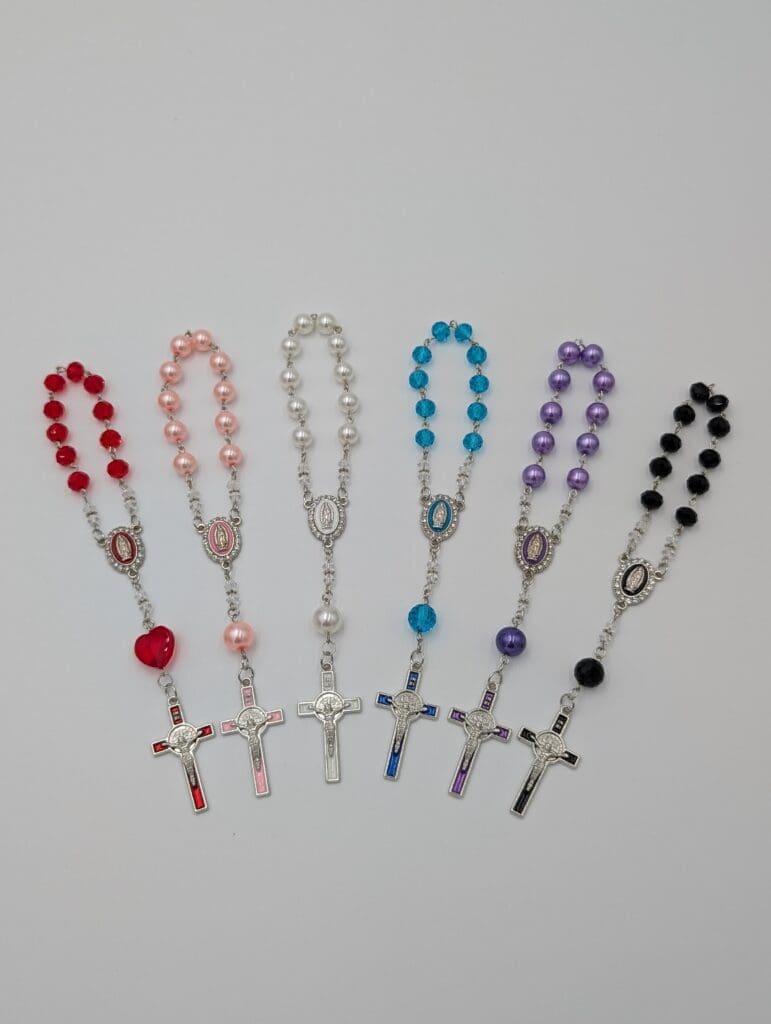
We make a wide variety of bespoke rosaries to include single decade versions. We use a variety of high-quality materials from gemstones, genuine crystals, marble, and metals to create unique instruments of prayer. We invite you to find the perfect rosary that is a true reflection of your personality. Can’t find what suits you? Simply give us a call, or send us text and we will work to create the right rosary for you.
Sign of the Cross: Simultaneously recite, “In the name of the Father, the Son, and the Holy Spirit” while touching the forehead, chest, left shoulder then right shoulder.
Apostle’s Creed: I believe in God, the Father almighty, creator of Heaven and Earth, and in Jesus Christ his only Son, our Lord, who was conceived by the Holy Spirit, born of the Virgin Mary, suffered under Pontius Pilate, was crucified, died and was buried. He descended into Hell; on the third day he rose again from the dead; he ascended into heaven and is seated at the right hand of God the Father almighty; from there he will come to judge the living and the dead. I believe in the Holy Spirit, the holy Catholic Church, the communion of saints, the forgiveness of sins, the resurrection of the body, and life everlasting. Amen.
Our Father: Our father, who art in Heaven, hallowed be thy name. Thy kingdom come, thy will be done on Earth as it is in Heaven. Give us this day our daily bread and forgive us our trespasses as we forgive those who trespass against us, and lead us not into temptation, but deliver us from evil. Amen.
Hail Mary: Hail Mary, full of grace, the Lord is with thee. Blessed art thou, and blessed is the fruit of they womb, Jesus. Holy Mary, Mother of God, pray for us sinners now and at the hour of our death. Amen.
Glory Be: Glory be to the Father, and to the Son, and to the Holy Spirit, as it was in the beginning, is now and ever shall be, world without end. Amen.
Fatima Prayer: Oh my Jesus, forgive us our sins, save us from the fires of Hell, and lead all souls into Heaven, especially those in most need of Thy mercy. Amen.
Hail Holy Queen: Hail, holy Queen, mother of mercy, our life, our sweetness, and our hope. To thee do we cry, poor banished children of Eve; to thee do we send up our sighs, mourning and weeping in this valley of tears. Turn then, most gracious advocate, thine eyes of mercy toward us; and, after this, our exile, show unto us the blessed fruit of thy womb, Jesus. O clement, O loving, O sweet Virgin Mary. Pray for us O holy mother of God, that we may be made worthy of the promises of Christ.
Rosary Prayer: Let us pray. O God, whose only-begotten Son by his life, death and Resurrection, has purchased for us the rewards of eternal life; grant, we beseech Thee, that by meditating upon these mysteries of the most holy rosary of the Blessed Virgin Mary, we may imitate what they contain and obtain what they promise, through the same Christ our Lord. Amen.
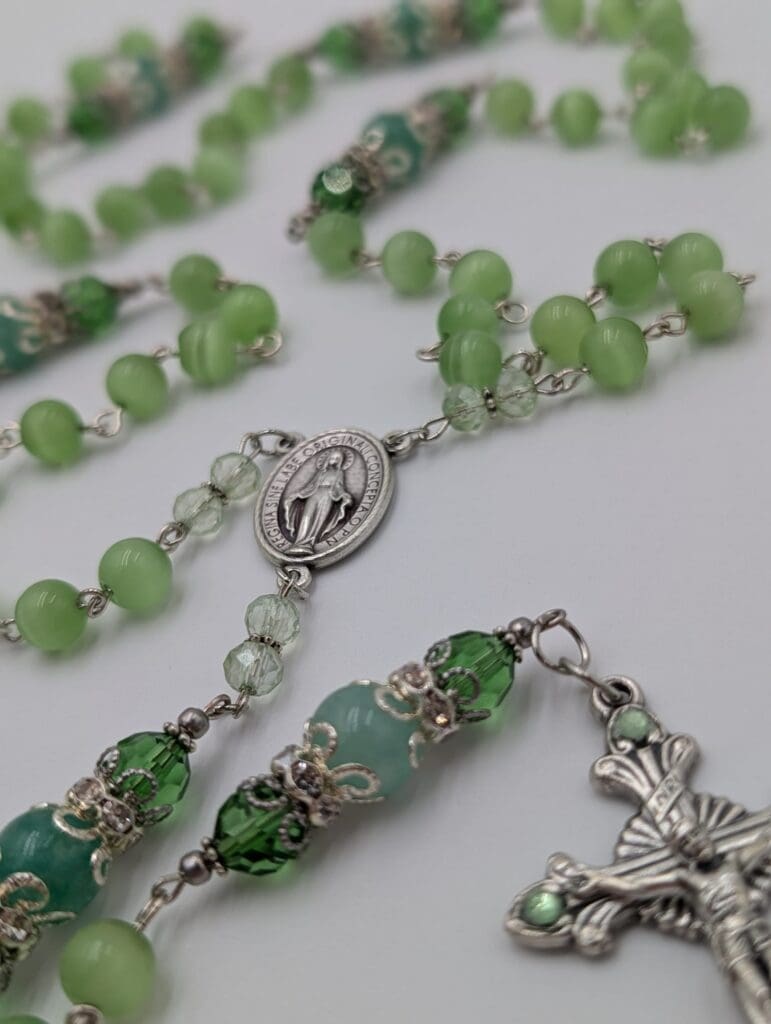
Taking time to pray the rosary offers more than a spiritual connection; it brings real benefits for your mental, emotional, and physical well-being. When you set aside moments for this prayerful practice, you invest not only in yourself, but also your physical health. Everyone is familiar with the benefits of prayer as a chance to calm your mind, center your thoughts, and nurture your spirit. What if the ancient obligation of prayer had more to do than just calming the mind and centering thoughts? What if there were bona fide physical benefits?
Scientific research increasingly supports what many have experienced for centuries: prayer has measurable healing effects. Medical researchers have found that reciting the rosary slows breathing, regulates heart rate, and helps blood flow more efficiently. By engaging in intentional prayer, you support your nervous system’s balance, reducing stress and enhancing your body’s natural healing processes.
Practicing the rosary also fosters a sense of calm that extends beyond the spiritual to the physiological. Evidence shows that focused prayer decreases anxiety and depression, supporting a more positive mood. When you embrace this practice, you strengthen your resilience to everyday challenges while challenging your ability to focus on each of the gospel mysteries. Incorporating the rosary into your day acts as a holistic form of self-care, nourishing the trifecta of mind, body and soul.
Understanding that prayer is more than words reveals a fascinating connection between your brain and body. When you pray the rosary, repetitive prayers encourage your nervous system to enter a calming state. This process works by calming the amygdala, the part of your brain responsible for processing stress and fear. Lowering the amygdala’s activity helps reduce feelings of anxiety and promotes relaxation, allowing your mind to reset.
Neural plasticity, your brain’s ability to adapt and form new pathways, is also positively influenced by consistent prayer. Regular rosary prayer strengthens circuits involved in empathy and attention, encouraging focus and emotional balance. This means that over time, you cultivate a gentler, more resilient mindset, improving your ability to navigate stresses and frustrations. Your brain rewires itself to respond with calm rather than reactivity.
Prayer’s impact on neural plasticity also supports recovery from past difficulties. By reinforcing positive thought patterns through prayer, you encourage your brain to heal from trauma and develop healthier emotional responses. This intentional practice fosters mental clarity and self-esteem, providing a foundation for overall wellness. Through the rosary, your brain develops new strengths that extend into daily life.
Praying the rosary benefits your cardiovascular system in ways you might not expect. As you intentionally focus on the mysteries of faith and methodically recite prayers, your heart rate naturally slows down. This slowing is similar to what endurance athletes experience, allowing the heart to pump blood more efficiently while decreasing overall strain. Lower heart rates reduce the risk of heart disease and improve long-term cardiac health.
Intentional prayer also helps lower blood pressure, a critical factor in your overall well-being. Hypertension can cause significant stress to your entire body, not just your heart. By dedicating about 20 minutes daily to prayer, you can experience a natural normalization of blood pressure levels. This process strengthens your body's capacity to maintain healthy function and resist the wear caused by constant stress.
Beyond physical measures, the calming rhythm of prayer brings a sense of mental tranquility that supports heart health. When your body relaxes, your nervous system benefits by reducing harmful stress hormones. This combination of mental and physical benefits showcases how the rosary prayer serves as a comprehensive practice that nurtures your heart, mind, and spirit alike.
You may notice that stress feels like a constant companion, as if your body is always on alert. This is the result of your sympathetic nervous system or the "fight or flight" response being overactive. When this system dominates, you may face increased heart rate, high blood pressure, irritability, and difficulty finding peace. Continuous activation makes it challenging to relax and enjoy moments of calm. As a result, this can kick off an overabundance of stress hormones, notably cortisol.
The parasympathetic nervous system acts as your internal regulator, encouraging relaxation, slower heart rate, and lower blood pressure. Activating this system allows you to access deeper peace and recovery. Prayer, especially the rosary, becomes an effective tool to engage this calming system, promoting emotional wellness and physical balance.
Through scheduled prayer time and connection to Mary, you create space to foster this balance. This sacred practice supports resilience against life’s challenges and restores your sense of calm, so you can face each day with renewed strength and peace. Let’s recount the various ways this devotional improves health:
• Rebuilding neural pathways to cope with stress
• Neural plasticity which may prevent dementia
• Regulating stress hormones
• Calming the heart rate
• Reducing blood pressure
• Eases anxiety and depression
• Providing calm for those suffering from Parkinson’s Disease (this is a separate article I am preparing based on tests at my clinic, TRACE | Body Rejuvenation on my clients and patients that have Parkinson’s – the results are astounding)
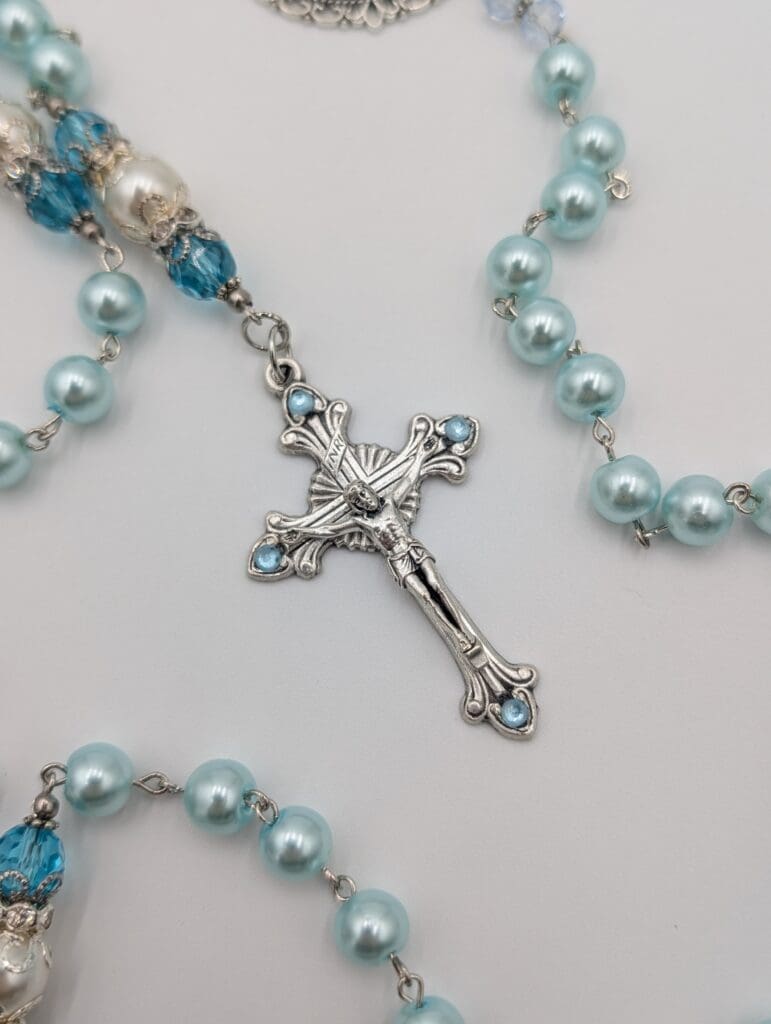
The things we buy reflect not only our style, but also our moods. We choose what to wear each day based on things like our mood, the weather, the social environment we will be in. I have a variety of rosaries that somehow speak to me in terms of the day’s gospel reflections, whether I’m in an upbeat or saddened state. That is, I reflect first upon what are the things I want my devotion to prayer to accomplish: to calm an anxious heart, uplift my mood further, connect to something important, etc.
This is where selecting the kind of rosary you want to pray with gets fun. If you are going through personal struggles that weigh heavily on your heart, perhaps you would enjoy one of our hematite rosaries. Hematite is an iron ore oxide and the root “hema” means blood in Greek. I like using hematite as it reminds me of the blood of Christ. So when my thoughts are heavy, I reach for one of these weighty rosaries. I feel like my heavy heart becomes lifted as my prayers lift my emotional burden.
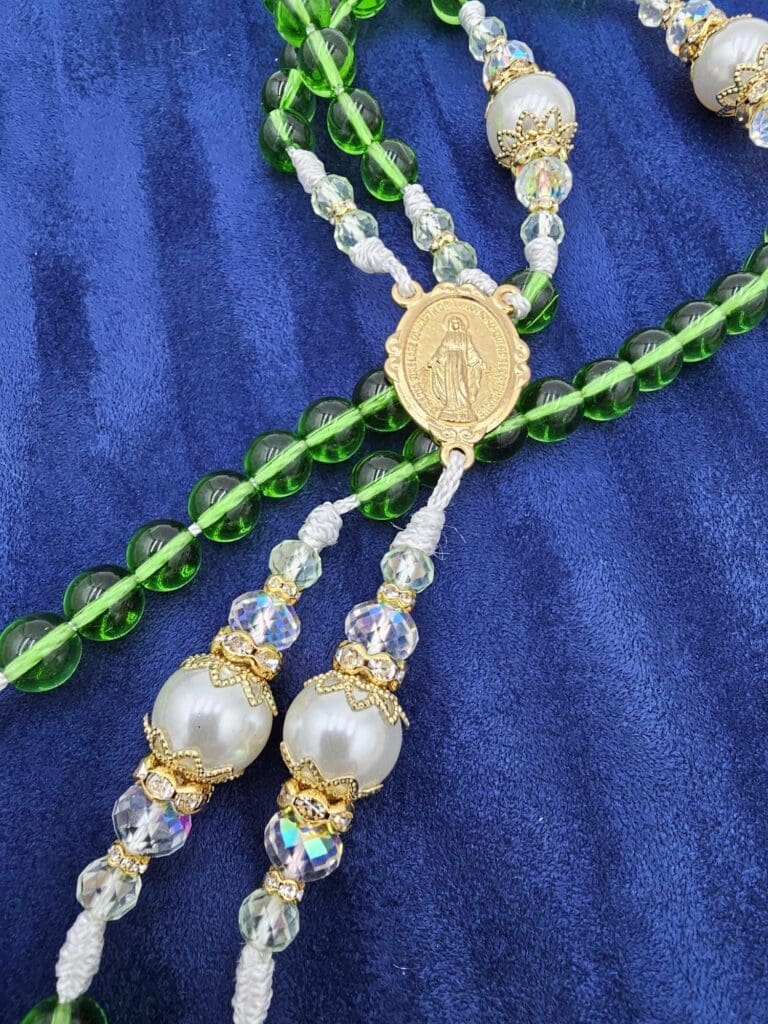
I love reflecting on the Joyous, Glorious and Luminous mysteries and for these meditations, I reach for super brightly colored and sparkly rosaries. I enjoy praying by a window in the morning sunlight and watching the colors dazzle and reflect on the walls and floors making prayer time a mesmerizing experience.
The rosary is so much more than an abacus to count out a bunch of prayers. No!! This is time for YOU! What colors do you gravitate toward the most? This isn’t just about the recitation of prayers but also a tactile experience. You are using your hands to draw each bead into your hand and on out – what do you want to feel? Facets of crystals? Smooth pearl-shaped crystals, or square beads? Square beads require your brain to process the tactile information differently from a round bead.
Finding the right rosary for you is part of the experience, and to bring a personal keepsake that accompanies you in your healing journey. Whether you pick one to match a daily reflection or your personality, this simple yet profound tool deepens your connection with Mary and strengthens your faith. Investing in a rosary is investing in yourself, fostering a healthier, more centered you.
Praying the rosary carries proven benefits that extend far beyond spiritual growth. You support your mental health, enhance neural pathways for calm and empathy, protect your heart, and balance your nervous system. Choosing a rosary that reflects your style or mood can make this practice joyful, not routine. As you open your heart to this prayer, you welcome peace, healing, and restoration into all areas of your life.
As you look through our gallery of rosaries, if there are materials or colors you don’t see in a combination that has you written all over it, please call or write to us and we can build the right rosary just for you. If you want to have a theme that fits not just you, but your family or prayer group, let us create the right thing for you.