The priest at my parish is not terribly fond of the rosary. He has said more than once, with something between exasperation and genuine theological concern, that Mary is not Mrs. God. That comment sent me down a longer path of reflection than he probably intended, because it raised questions worth sitting with honestly. What is the rosary actually for, what does Mary want from us when she appears and asks us to pray it, and why has the Catholic Church recently felt the need to address how some people practice Marian devotion? What I found, when I worked through it carefully, is that the controversy says more about human nature than it does about any real problem with the rosary itself.
Try for a moment to imagine Mary's life from the inside. She was approximately fifteen years old, betrothed to Joseph, when a holy messenger arrived to tell her she would carry a child who was God made human. She could have been stoned to death for turning up pregnant before her marriage was formalized, and yet she said yes, Joseph stood by her, and together they raised one of the most documented and discussed people in all of recorded human history. That is not a small assignment, and the weight and wonder of it most of us can barely begin to hold in our minds.
She then spent years watching him grow up in the ordinary rhythms of daily life before his public ministry began at the Wedding at Cana. Before the world knew who he was, she had already witnessed hundreds of quiet moments that confirmed everything the angel had told her. She knew things about him that nobody else in the world knew, in the way that only a mother knows her child through decades of small daily observations accumulated in private. That front-row seat to his nature, his capacity for love, and the slow unfolding of his purpose is what she carries into every approved apparition, and what she is trying to share when she asks people to pray the rosary.
She is not asking us to worship her. She is pointing at her son the way proud mothers do, persistently and with complete conviction, saying simply: "Look at him, look at what he has given you, look at what his life means for yours." Praying the rosary is not an act of elevating Mary to a position she never claimed and would not want. It is an act of following her gaze toward Christ, which is precisely where she has always directed it.
I have met practicing Catholics who follow ritual more from long habit than from the reflective engagement that gives ritual its meaning. Without a solid biblical foundation beneath the practice, it is genuinely possible to look at the Vatican-approved Marian apparitions, connect them to Mary's singular role as the mother of God incarnate, and begin sliding toward something that resembles veneration of Mary as a figure of near-divine status rather than the Gospel-centered meditation the rosary is designed to produce. The Catholic Church has officially recognized roughly 26 significant Marian apparitions out of the thousands reported across centuries, which reflects its appropriately cautious role as the institution responsible for keeping the faith grounded in scripture and tradition. The fact that those approved apparitions are real and theologically significant makes it understandable, if not correct, that some people's devotion tips further than it should.
I think about my own mother when I try to understand Mary's actual role. There were people in my life who thought the path to getting closer to me ran through winning my mother's favor first, and my mother, who knew me better than anyone alive, was unfailingly clear-eyed about exactly who those people were and what they actually wanted. A genuinely discerning mother uses her knowledge of her child in service of love, and she can separate what is genuinely good from what merely presents itself that way. Mary functions in a similar way within Catholic tradition, not as a destination in herself, not as an obstacle between us and Christ, but as a mother who knows her son completely and spends every available moment trying to help the rest of us see what she has always seen in him.
Pope Leo XIV's intervention reflects a pastoral concern for Catholics who have, through no bad intent, allowed their understanding of Mary's role to expand beyond what scripture and tradition actually support. That kind of course correction is precisely what the Church exists to provide, and it does not diminish the rosary or legitimate Marian devotion one bit. It clarifies what the rosary has always been: a structured invitation to meditate on the life, death, and resurrection of Christ, with Mary as the guide who leads us to those mysteries because she lived them more closely than any other human being. Resetting that understanding is not a rejection of Mary. It is a restoration of what her role has always actually been.
The Hail Mary itself explains the theology plainly for anyone who reads the words with real attention. The first half describes a specific historical moment with striking directness: “Hail Mary, full of grace, the Lord is with thee,” acknowledges that she is carrying God incarnate inside her, an event without precedent or repetition in all of human history. “Blessed art thou amongst women and blessed is the fruit of thy womb, Jesus,” identifies both her singular position among every person who has ever lived and the source of that distinction, which is entirely her son. The second half, “Holy Mary, Mother of God, pray for us sinners now and at the hour of our death,” is a request for intercession, asking a mother to advocate for us with the son she knows more intimately than anyone. It is not worship. It is asking a devoted mother to put in a word on our behalf, which is among the most human and instinctive things a person can do.
The mysteries of the rosary function as the Gospel on beads, organizing the significant moments of Christ's life into a sequence that walks the person praying from the Annunciation through the Resurrection and beyond. Each mystery invites a specific kind of reflection: the Wedding at Cana asks you to sit with the moment his public life began and what it cost Mary to release him to it, the Crucifixion asks you to consider what love looks like at its most costly, and the Resurrection asks you to hold the promise that all of that cost was not the end. Praying through them is not passive recitation of memorized words. It is active engagement with the narrative of the Gospels, repeated often enough that those moments begin to feel personally meaningful rather than distant and historical.
The rosary also creates a container of genuine quiet in a world that offers very little of it. Setting aside the time to pray it, closing the door on the noise of daily life, and directing real attention toward the life of Christ is itself an act of reverence that reflects what Mary has asked for consistently across every approved apparition. She asks for prayer, for turning away from what diminishes us, and for a movement of the heart toward her son. The rosary accomplishes all three simultaneously when it is prayed with genuine attention.
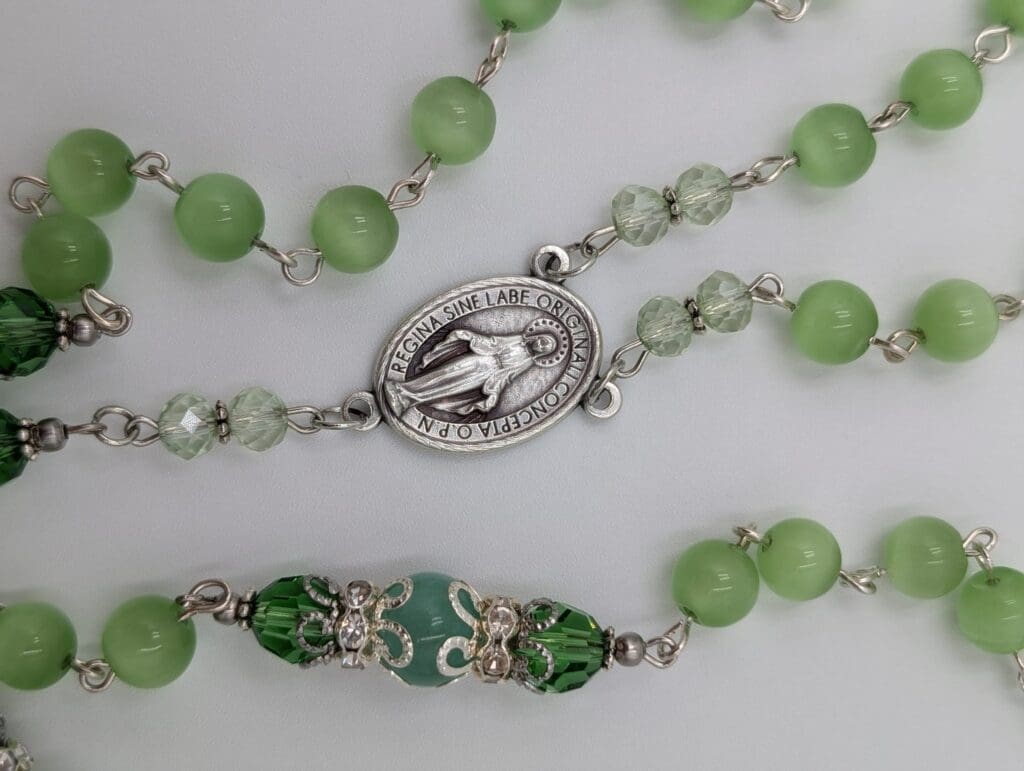
Faith in Mary grew out of exactly this kind of reflection on what the rosary is and what it deserves to be as a physical object held during prayer. Every custom made rosary in our Houston workshop is built with careful attention to materials, link construction, and the balance of the piece in the hand, and we pray through the mysteries as we assemble each one. By the time a rosary leaves our hands it has already been offered up many times over, which matters to us even if the person receiving it never knows it. We have been moved by how many men are finding their way to contemplative prayer through the rosary, and we have designed pieces specifically for that, using heavier materials like hematite, marble, quartz, and jade that sit with real presence in the hand during extended prayer.
For those drawn to something that carries light with it, we work with Austrian and Czech crystal that refracts color in a way that makes even a simple moment of prayer feel like it deserves the attention it is getting. Every piece in the gallery at faithinmary.com reflects a different personality and a different approach to this practice, because the most beautiful rosary is ultimately the one that makes you want to pick it up and use it. If nothing in the gallery speaks to you, we welcome the conversation about creating a custom made rosary built around who you are and how you pray. We also restore and repair family heirloom rosaries, because a piece that has been prayed with for decades deserves to be made whole again rather than forgotten in a drawer.
The goal in everything we make is a rosary that draws you back to it regularly and toward the life of Christ it is designed to help you reflect upon. Mary has been consistent across every credible apparition: pray, turn toward her son, and let that attention do what it has always done for the people willing to give it honest time.
The controversy around the rosary is ultimately a reminder that how we understand a spiritual practice determines how we engage with it. Mary is not asking to be worshipped. She is asking us to notice her son, to sit with the moments of his life, and to let that attention do what it has always been capable of doing. Contact us today if you have questions about a custom made rosary, a rosary that needs restoring, or simply want to find the one that feels right for where you are in your prayer life.